

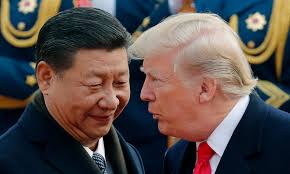
Sudden suspension of aid funding a ‘perfect opportunity’ for Beijing to fill the gap and grow its own soft power
Donald Trump’s shutdown of USAid has already had disastrous effects on humanitarian aid and development programmes around the world, but it has also ceded ground to the US’s chief rival, China, analysts have said.
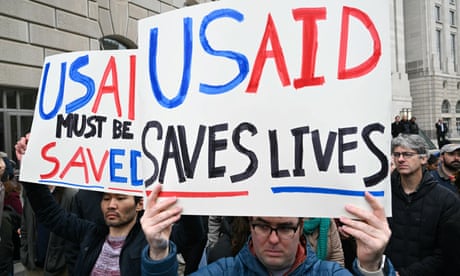
The result of the sudden 90-day suspension of USAid funding – which accounts for 40% of global foreign aid – has been chaos: employees locked out of offices, humanitarian shipments left to rot, and lifesaving assistance stopped. Around the world, development programmes previously assisted by the USAid are panicking, warning of disastrous risks of escalating famine, death and disease.
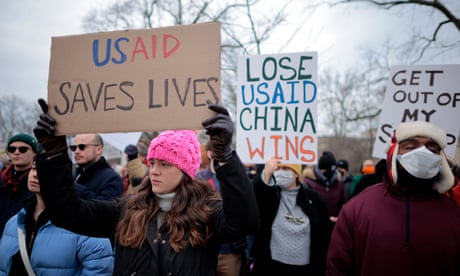
Trump’s plan involves the merger of the more than 60-year-old USAid into the state department, shrinking its workforce and aligning its spending with his priorities. But analysts say it is working against one key priority – countering China.
“[The US is handing] on a silver platter to China the perfect opportunity to expand its influence, at a time when China’s economy is not doing very well,” said Prof Huang Yanzhong, senior fellow for global health at the Council on Foreign Relations.
“What Trump is doing is basically providing China a perfect opportunity to rethink, to renew soft power projects, and get back on track to transglobal leadership.”
More than one analyst described the shuttering of USAid as a “self-inflicted wound”.
Global dynamics have been dominated by the ongoing US-China competition and a key battlefront is in the development sector as Washington and its allies vie against Beijing for influence in the global south.
In 2018, the Chinese government created the standalone China International Development Cooperation Agency, or China Aid, to streamline China’s spending, including its foreign investment programme, the belt and road initiative (BRI). Beijing doesn’t disclose foreign aid budgets but a study by William & Mary’s Global Research Institute found China lent $1.34tn to developing nations between 2000 and 2021, mostly through the BRI. The new agency would “further the effectiveness of aid as a key foreign policy instrument”, according to a government press release at the time.
While China Aid operates differently to USAid, by focusing more on loans and highly visible infrastructure projects rather than partnering with local organisations, both agencies have similar objectives – spreading their respective government’s soft power and influence.
It’s particularly focused on the Pacific, where the US, Australia and other allies have been trying to counter China’s efforts to make security deals with the small but strategically located countries.
Tom Wang, the executive director of Manila-based People of Asia for Climate Solutions, an environmental NGO that works in the Philippines and China, warned against “simplistic” narratives of China replacing US soft power overnight.
Wang, whose organisation does not receive any US or Chinese government funding, noted that Chinese funders did not have the same long history of overseas development as USAid. “It’s not just the disappearance of money, it’s the disappearance of experience,” he said.
Wang said that a bigger presence for China in the environmental space could be a blessing in disguise for some NGOs. “China might not be as good at supporting local groups in terms of financials, but what China is good at is technology, knowledge sharing, especially when it comes to renewable energy.”
Still, Wang said, for NGOs in his sector, following the USAid stoppage, “the biggest impact is the anxiety”. He added: “All of a sudden, you have no way to continue your work … as an NGO campaigner or a climate activist, it’s quite a scary thing.”
Melissa Conley Tyler, executive director of the Asia Pacific Development, Diplomacy and Defence Dialogue, tsaid she knew of at least one confirmed case in the region where China Aid had already stepped in to provide the funds pulled by USAid.
“The US and Europe, Canada, Australia, Japan, we have a strong interest in living in a world of liberal democracies and economies,” said George Ingram, a senior fellow at the Brookings Institution’s centre for sustainable development and a former USAid official.
“China, like Russia, is trying to advance an authoritarian world. The total opposite of what our interests are.”
For now, any new China Aid support would be mostly rescuing programmes abandoned by USAid, like the example in the Pacific. But down the track that could change, Conley Tyler said.
“My biggest worry about China as a development actor is the way it often corrodes good governance and accountability in the country where it works. I don’t have a problem with any country being a development party … it’s a wonderful thing. But the way China does aid can have a sort of corrupting effect on that.”
There was also likely to be greatly reduced bargaining power for recipient nations. With USAid gone, programmes that previously reaped the benefits of two superpowers competing to fund their projects might just have to take what they can get.
“They don’t have to significantly increase funding of the foreign aid levels in order to replace the US as leader in this field,” said Huang. “And … its narrative about international development, about how altruistic China is, becomes more convincing. So that also helps boost China’s soft power quickly.”
Conley Tyler said the impact of the USAid suspension is far worse than what’s being reported because many programme workers are hoping if they keep quiet, funding might be restored at the end of the 90 days.
But even if it is, broadly, the trust is gone.
“Who is going to allow themselves to become dependent on US assistance if it’s fickle, if it doesn’t distinguish between allies and adversaries, if it could just be turned off on a political whim?” she said.
Additional research by Jason Tzu Kuan Lu
This is what we’re up against
Bad actors spreading disinformation online to fuel intolerance and undermine democracy.
A media ecosystem dominated by a handful of billionaire owners.
Teams of lawyers from the rich and powerful trying to stop us publishing stories they don’t want you to see.
Lobby groups with opaque funding who are determined to undermine facts about the climate emergency and other established science.
Authoritarian states with no regard for the freedom of the press.
***
But we have something powerful on our side.
We’ve got you.
This is why we’re inviting you to access our brilliant, investigative journalism with exclusive digital extras to unlock:
1. Unlimited articles in our app
2. Ad-free reading on all your devices
3. Exclusive newsletter for supporters, sent every week from the Guardian newsroom
4. Far fewer asks for support
5. Full access to the Guardian Feast app
The Guardian is funded by readers like you in Venezuela and the only person who decides what we publish is our editor.
Fuente: